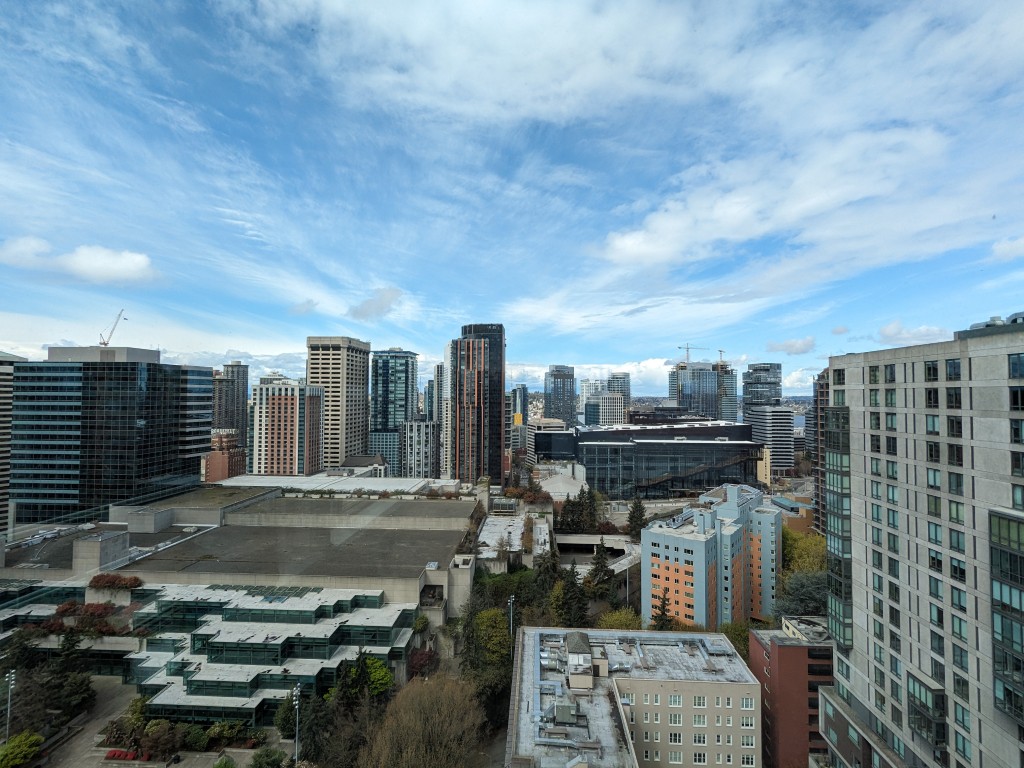
Arch, foreground. Summit, center.
Three years ago, Seattle Convention Center opened the Summit, a new $1.9 billion building just two blocks away from the old building. It's an architectural marvel, LEED-certified, with flexible space ideal for conference planners.
But nobody was planning for a pandemic. SCC had financed the Summit with $1.6 billion in lodging tax bonds — secured against Seattle hotel revenue. Then COVID hit mid-construction and that revenue collapsed. King County stepped in with $100 million in emergency support; Sound Transit sold the PFD its Convention Place Station site for $161 million. The Summit opened in January 2023 at $1.9 billion — $300 million over budget — and the debt load it left behind is what makes the finances fragile today.
There's now a light rail train to Bellevue, which means conference guests can easily stay across the lake in new luxury hotels. If enough do, SCC won't be able to cover its bond payments — and until 2029, the state is on the hook for any shortfall. After that, Seattle owns the problem alone.
Look to the Arch — the original Washington State Convention Center — 435,000 square feet in the heart of the Pike-Pine corridor, which stretches from Pike Place Market to Capitol Hill.
For roughly 250 days a year, SCC schedules no public programming whatsoever at the Arch. That's 250 days when the building could be hosting markets, performances, and gatherings — office workers on lunch breaks, meetups large and small, music and dance performances, art displays and exhibitions. Give the most educated big city in America a place to meet, and they'll show up — and keep showing up.
That's why we need Seattle Commons.
What if the City of Seattle got the keys to the Arch from SCC and ran it 365 days per year — a magnet that gives local and regional visitors a reason to come to Downtown Seattle, filling the corridor between Pike Place Market and Waterfront Park with the foot traffic it's been missing?
And sure, SCC can lease the space back whenever they need it. But it's no longer a dead zone on non-event days.
Seattle Commons — food hall, public space, programming, and more.
This site builds the coalition to make it happen.