A Better Story to Sell
Visit Seattle markets the city. The Commons gives them more to work with.
Visit Seattle does three things: sells the convention center to out-of-town events, supports visitors planning and arriving, and supports member businesses. The Commons helps with all three.
Three roles, each with different needs
Visit Seattle has two major funding streams. The first is a Tourism Promotion Area (TPA) assessment on qualifying downtown hotel room nights — a charge legally distinct from the lodging tax. The second is a direct marketing contract with the WSCC PFD, funded from lodging tax revenues. Visit Seattle's FY2024 Form 990 shows total revenue of $36.5 million; the PFD's FY2024 audit names the convention center's contribution as $10.6 million. The STIA assessment accounts for most of the remainder, though the 990 doesn't break it out separately.
That combined funding supports three distinct functions — and the Commons affects each one differently.
What the Arch calendar actually looks like
The Arch has events on 115 days a year. The other 250 have no public programming — no reason to show up. That's not an estimate; it's the 2026 booking calendar on the SCC's own website.
250 days is a full working year: 52 weeks at five days, minus two weeks vacation. The building sits idle for the equivalent of every workday you put in annually.
When the Arch is open, the median day brings 667 people — a medical conference, a professional association meeting, a nonprofit gala. The building comes alive seven times a year for big consumer shows: the Flower & Garden Festival, Sneaker Con, Comic Con, Sakura-Con, PAX West, Oddities & Curiosities, the National College Fair. Those seven events drive 67% of the Arch's annual attendance from fewer than 15 days of use. The standard deviation of daily attendance is nearly twice the mean. Most days are quiet. A few are enormous. The rest of the year is dark.
The Commons changes the 250 days with no public programming. The Arch stays bookable — WSCC retains the right to schedule events as they always have. The big consumer shows still come. Conferences still run. When a group wants the building to themselves, they have it. What changes is the baseline: the building has something in it on every other day of the year.
Event planners do site visits before committing. The blocks around the Summit have hollowed out — the Cheesecake Factory closed, the Starbucks Reserve Roastery closed. What planners see when they arrive on a non-event day is what the city looks like most of the time. The Commons is a real change to what they find — not a claim in a pitch deck, but something that's there when they arrive.
The Arch visitor center, open when the Arch is open
Visit Seattle operates a visitor information center inside the Arch at 7th and Pike. It's open to anyone — but staffed only for the larger events. On the 250 days with no public programming, and most of the event days too, the screens run and the brochures sit and nobody's behind the counter.
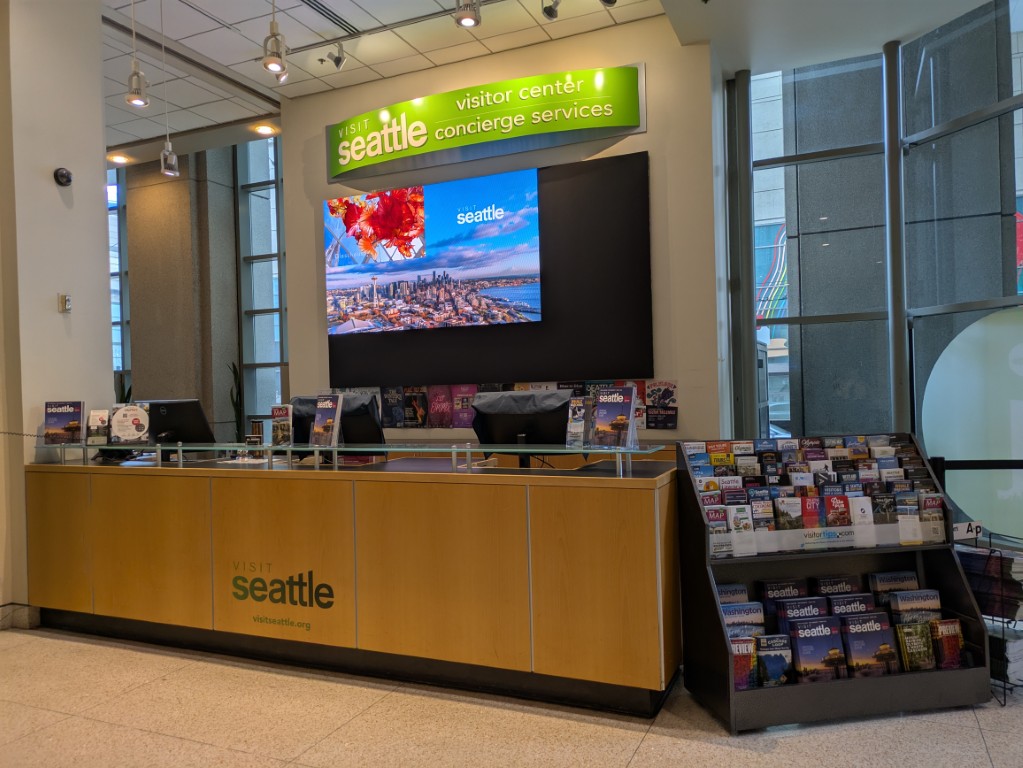
The desk is open to anyone — but staffed only for the larger events. Most of the 115 event-days, and all of the 250 days with no programming, the screens cycle and the brochure rack sits full and the counter is empty. A commons that runs the Arch year-round staffs this desk year-round.
Members need people in the corridor, not just during events
The Arch runs 115 event-days a year. For the businesses around it — restaurants, coffee shops, bars, retail — those days are good. The other 250 are not.
Visit Seattle's members can't live on convention traffic alone. The Pike/Pine corridor needs year-round foot traffic — people who are here because there's something to do, not because a trade show happened to land this week.
The Commons brings a different kind of visitor to the neighborhood: someone who came for the market, or the co-working space, or an evening event, or just because the building is open and interesting. That person eats lunch somewhere on Pike Street. They browse. They come back. That's the steady-state customer Visit Seattle's members need, and that marketing alone can't create.
Marketing follows the product. The Commons is the product.
What event planners see when they evaluate Seattle
- —Two convention centers (which do I book?)
- —Arch has no public programming 250 days a year
- —Neighborhood is quiet between events
- —Visitor center staffed only for big events
- —Downtown is struggling (and it shows)
- —Delegates walk out to an empty block
- ✓Summit: the convention venue
- ✓Arch: open daily, still bookable for events
- ✓Neighborhood activated 365 days a year
- ✓Visitor center open when the building is open
- ✓Downtown story is a comeback, not a decline
- ✓Convention delegates walk into a destination
Open the Arch
Visit Seattle's job is to market Seattle. The Commons gives them something better to market: a city that invested in its own public life, not just its convention business. A neighborhood that's worth walking through on a Tuesday, not just during a trade show.
The Arch — the Convention Center's former event hall at 7th and Pike — is already here. Operated as a year-round public commons by Seattle Center, it becomes the daily anchor Visit Seattle's story has been missing. Convention delegates have somewhere to go. Members have foot traffic on off days. Visitors have a staffed information center. And the sales pitch gets a lot simpler.
The Arch is a WSCC public facility. A new operating agreement with Seattle Center — a board decision, not a legislative one — is the path.
Tell the people who can make this happen that you want it.